MIT Media Lab
Learn with a tutor that pays attention
NeuroChat adapts to your focus in real-time using brain-computer interface technology. Experience personalized learning that responds to how you think.

How It Works
NeuroChat combines cutting-edge neuroscience with AI to create a learning experience that truly adapts to you.
Brain-Sensing Technology
Using the Muse EEG headband, NeuroChat monitors your brain activity to understand when you're focused, confused, or drifting away.
Adaptive AI Tutor
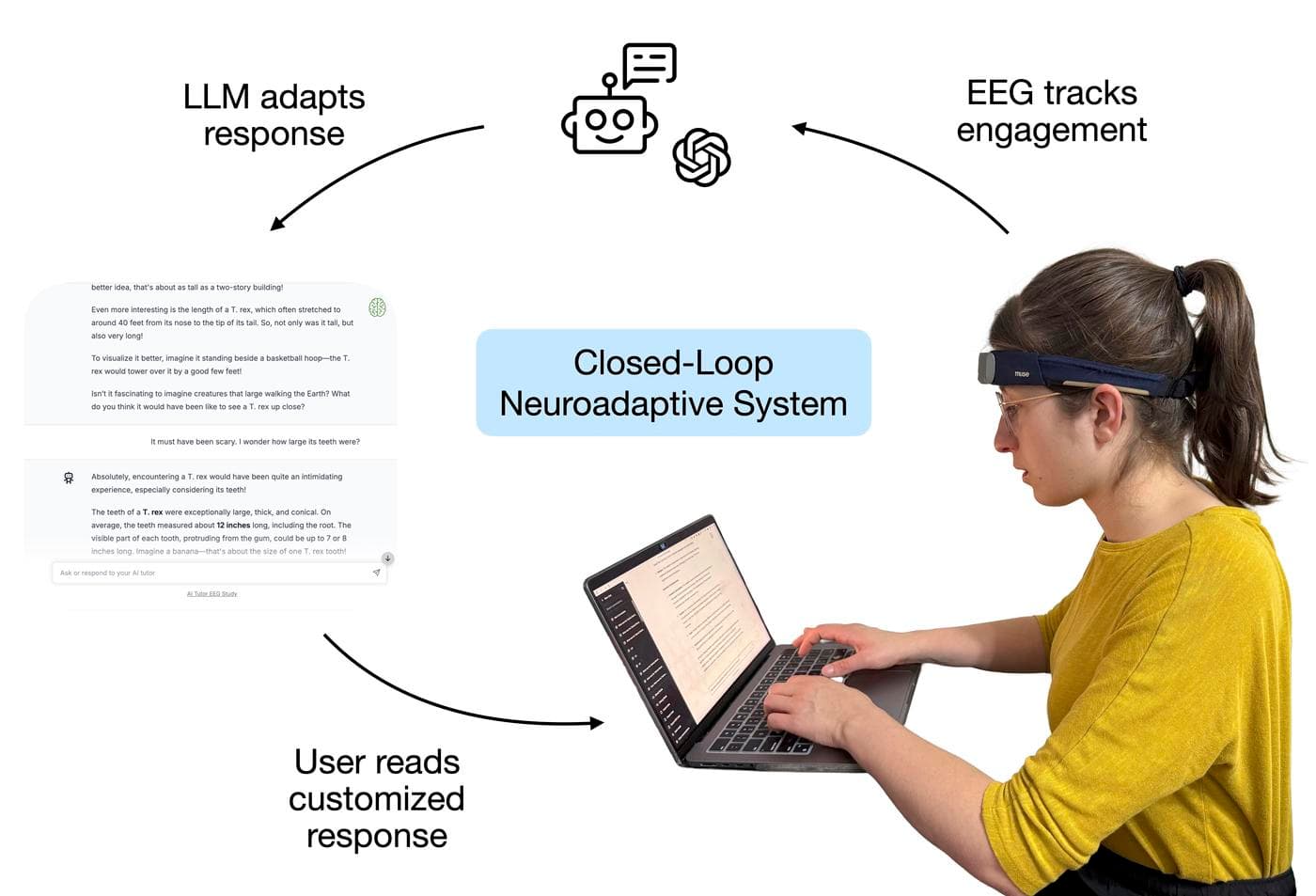
The AI tutor dynamically adjusts its teaching approach based on your cognitive state—simplifying when you struggle, challenging when you're engaged.
Personalized Learning
Every session is tailored to how your brain works. Get content paced perfectly for your attention span and learning style.
The Feedback Loop
You Learn
Engage with the AI tutor while wearing the Muse headband
We Sense
EEG signals reveal your attention level and cognitive load
AI Adapts
The tutor adjusts difficulty, pacing, and approach in real-time
Research
The Science Behind NeuroChat
Our research demonstrates significantly higher engagement when AI tutors adapt to cognitive states in real-time.
Research Paper
NeuroChat: Enhancing AI Learning through Brain-Computer Interfaces
This research explores the potential of integrating brain-sensing technology with AI-powered tutoring systems to create adaptive learning experiences. By monitoring learners' cognitive states through EEG data, the AI tutor can dynamically adjust content difficulty, pacing, and teaching approach.
Our study demonstrates significantly higher engagement when AI tutors adapt to cognitive states in real-time, with participants reporting a more positive learning experience.
Key Findings (n=24)
- ✓Significantly higher EEG-measured engagement (p = 0.029)
- ✓2.3× more participants reported positive engagement vs. control
- ✓Real-time BCI adaptation enables personalized learning pacing
Our Team

Dünya Baradari
Research Lead
Graduate Student at MIT Media Lab focused on context-aware AI and brain-computer interfaces.

Nataliya Kos'myna
Research Lead
Research scientist at MIT Media Lab developing end-to-end brain-computer interfaces.

Pattie Maes
Principal Investigator
Professor at MIT Media Lab and head of the Fluid Interfaces research group.

Nikos Bellos
Developer
Research engineer focused on brain-computer interfaces and adaptive learning systems.
About MIT Media Lab
The MIT Media Lab is an antidisciplinary research laboratory at the Massachusetts Institute of Technology devoted to projects at the convergence of technology, multimedia, sciences, art, and design.
The Fluid Interfaces group creates technologies that enhance our cognitive abilities, empowering us to be more creative, learn more effectively, and improve our wellbeing.

FAQ
Frequently Asked Questions
Everything you need to know about learning with brain-sensing AI.
NeuroChat is an AI-powered learning assistant that adapts to your cognitive state in real-time using brain-sensing technology. It combines the Muse EEG headband with advanced language models to deliver personalized learning experiences based on your current level of attention and cognitive load.
NeuroChat uses the Muse EEG (electroencephalography) headband to measure your brain activity. The headband has sensors that detect electrical signals from your brain. These signals are processed to extract metrics related to attention and cognitive load. The system then adjusts the AI tutor's responses based on these metrics, providing more challenging content when you're engaged and simplifying explanations when you're struggling.
While the full NeuroChat experience requires a Muse EEG headband to enable the adaptive features based on your brain activity, you can still use the application in manual mode without the headband. In manual mode, you can manually indicate your attention level, allowing the AI to adapt accordingly.
Your privacy is our priority. Raw EEG signals are processed locally on your device and never leave it. We only store your conversation history and anonymized learning metrics to personalize your experience. Any research insights are fully anonymized and aggregated—your individual data is never shared with third parties.
NeuroChat can help you learn any topic you'd discuss with a tutor—from mathematics and science to languages, history, and programming. The AI adapts its teaching style based on your cognitive state, making it effective for complex problem-solving, concept explanation, and skill development.
NeuroChat is a research project from MIT Media Lab. Currently, it's available as part of our research studies. Contact us if you're interested in participating in our research or learning more about access options.
Legal
Legal Information
Important information about using NeuroChat and how we handle your data.
Welcome to NeuroChat. By accessing or using our service, you agree to these Terms of Use. NeuroChat is a research project of the MIT Media Lab and is provided for educational and research purposes only.
Use of Service
NeuroChat is not intended for clinical use and should not be used for medical diagnosis, treatment, or as a substitute for professional medical advice. The brain-sensing features are experimental and for educational purposes only.
Limitations
Access to and use of NeuroChat is provided on an "as is" basis. MIT Media Lab does not guarantee the accuracy, completeness, or usefulness of the service or any content provided through the service.
User Conduct
You agree not to use NeuroChat for any illegal or unauthorized purpose. You must not attempt to probe, scan, or test the vulnerability of the system or breach any security measures.
Intellectual Property
NeuroChat and its original content, features, and functionality are owned by MIT Media Lab and are protected by international copyright, trademark, patent, and other intellectual property laws.
At NeuroChat, we prioritize your privacy and are committed to protecting your personal information. This Privacy Policy explains what information we collect and how we use it.
Data Collection
NeuroChat collects minimal information to personalize your learning:
- Account Information: Email address for authentication
- Conversation Data: Your conversations with the AI tutor
- Learning Metrics: Anonymized engagement patterns to improve your experience
- Profile Information: Optional name and learning preferences
How We Use Your Data
- Personalize your learning experience
- Process brain signals locally to adapt AI responses in real-time
- Improve NeuroChat through anonymized, aggregated research insights
Privacy by Design
Brain Signals: Raw EEG data is processed entirely on your device and never transmitted or stored.
Research Use: Any data used for research is fully anonymized and aggregated—your individual information is never identifiable.
NeuroChat is committed to maintaining the highest standards of data security and user privacy.
Security Measures
- User authentication and authorization controls
- Encrypted data transmission using HTTPS
- Regular security assessments and updates
- Limited access to user data by authorized personnel only
Third-Party Services
- Supabase: Secure user authentication and data storage
- OpenAI API: Powers the AI conversations
- Vercel: Hosts our web application
Your Rights
You have the right to:
- Access the personal information we have about you
- Request correction or deletion of your data
- Export your conversation history
- Opt out of research data collection
To exercise these rights, please contact us at neurochat@media.mit.edu
Contact
Get in Touch
Have questions about NeuroChat? We'd love to hear from you.
MIT Media Lab — Fluid Interfaces Group
Address
MIT Media LabFluid Interfaces Group
75 Amherst Street
Cambridge, MA 02139
United States
Connect with Us
NeuroChat is a project of the MIT Media Lab's Fluid Interfaces group. Learn more about our research initiatives and technologies.